Your truck is purpose-built for high strength, torque, and long-haul durability, but even the most rugged engines rely on exact internal timing. Whether you use your truck for commuting, heavy towing, work, or in a fleet, engine reliability is non-negotiable. At the heart of that reliability is one thing a lot of owners never give a second thought to: the timing belt or timing chain.
These components synchronize your engine’s internal moving parts. With proper care, they can make your truck run like a dream for years. If neglected, they can cause catastrophic engine damage and very expensive repairs. Understanding how they work and how to maintain them can protect your investment and prevent unexpected breakdowns.
Timing Belts Vs. Timing Chains | Understanding the Role
Before you can fix it, you’ve got to know what you’re dealing with. While the big semi-trucks often use gears, most light-to-medium-duty work trucks run on one of these two setups:
The Timing Belt
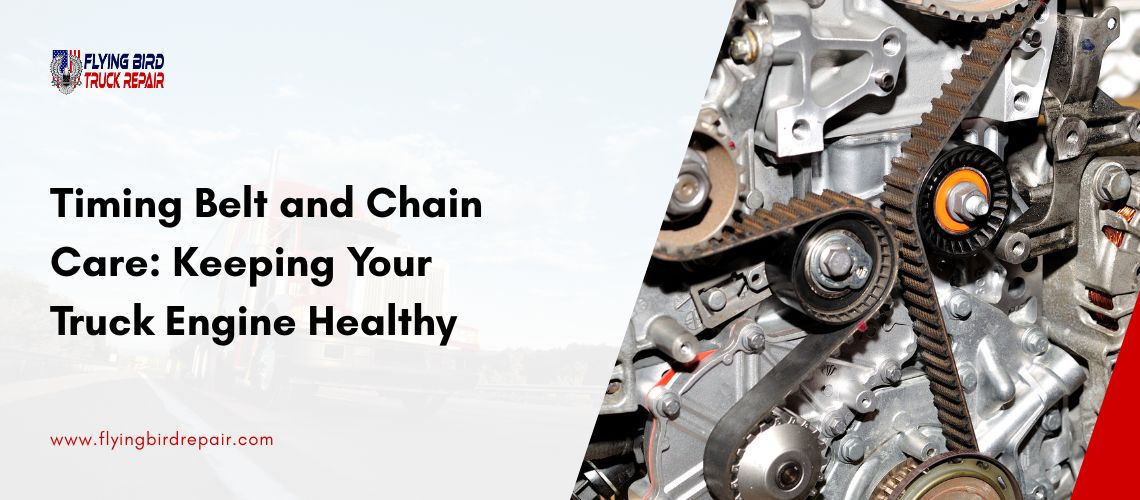
A truck timing belt is made of reinforced rubber with high-strength internal fibers. It is lightweight, efficient, and quiet-working. A lot of light-duty and medium-sized trucks are equipped with timing belts because they make less noise and they are cheaper to produce.
But rubber tends to break down. Cracking, fraying, or weakening due to heat, friction, and age. That is why timing belts need to be replaced on a regular schedule – even if they seem to be running fine.
The Timing Chain
This looks exactly like it sounds—a heavy metal chain, kind of like what you’d see on a bike but beefier. These live inside the engine and get bathed in oil. Timing chains are typical for heavy-duty, diesel, and performance-oriented engines.
Timing chains work differently from belts as they run inside the engine and need to be lubricated by the engine oil. Though they are made for long service life, they can stretch or wear prematurely if oil changes are not kept up with.
Key Signs Your Truck Timing Belt or Chain Needs Attention
These things are hidden, so you can’t usually see what’s happening inside. But they give some hints that can prevent major issues.
Signs of a Bad Timing Belt
If you’re getting close to that mileage mark in the manual, listen for these:
- The Ticking: A fast, repetitive ticking from the engine bay. It often means the belt is fraying or wearing thin.
- Rough Idle: If the belt slips even one tooth, your timing gets thrown off. The engine might feel like it’s stumbling or shaking when you’re stopped at a light.
- Oil Leaks: If you see oil dripping from the front of the motor, worry. If that oil gets onto the rubber belt, it’ll eat through it fast.
Signs of a Bad Timing Chain
Chains don’t usually snap out of nowhere; they stretch first. Watch for:
- The “Death Rattle”: This is the big one. On a cold start, you hear a loud clatter for a few seconds that fades as the engine warms up. That’s usually the chain slapping around because the tensioner is failing.
- Metal in the Oil: If you change your oil and see glittery metal flakes, that’s bad news. It likely means the chain is grinding against the housing.
- The Check Engine Light: Trucks are smart these days. If the timing is off by a hair, the computer will throw a code—usually something about “Camshaft/Crankshaft Correlation.”
Why You Can’t Just Risk a Broken Timing Belt or Chain
You might be thinking, “If it breaks, I’ll just tow it and fix it then. No big deal, right?”
Wrong. In most cases, it’s a huge deal.
It comes down to whether you have an interference or non-interference engine. In the old days, non-interference engines were common. If the belt broke, the engine just stopped. No harm, no foul.
But most modern trucks use interference engines to get more power and better compression. In these engines, the pistons and valves share the same space—they just take turns being there. The timing belt is the only thing stopping them from crashing into each other.
If that belt snaps, the dance is over. The pistons smash into the open valves. You end up with bent valves, a wrecked head, and destroyed pistons. Basically, your engine is toast.
Maintenance Rules You Must Follow
To keep your trucks earning money instead of sitting in the shop, follow these two rules.
Rule #1: Respect the Belt Interval
If the manual says change it at 100,000 miles, do it. Don’t try to squeeze out another 10k. You’re betting a $10,000 engine to save a few hundred bucks.
Preventive timing belt replacement may cost several hundred to just over a thousand dollars, depending on the vehicle. In contrast, repairing internal engine damage after a failure can cost several thousand dollars—or require a complete engine rebuild.
Rule #2: For Chains, Oil is Life
Timing chains need oil for lubrication and to keep the hydraulic tensioners tight. If you skip oil changes, sludge builds up and blocks the little ports that feed the tensioners. No pressure means a loose chain, and a loose chain eventually breaks. Your oil change schedule is your timing chain care and maintenance.
Bottom Line
Your truck’s timing components are the unsung heroes of your daily route. They work silently under high heat and immense stress to keep your business moving forward. Whether your fleet runs on rubber belts or metal chains, the strategy remains the same: proactive care wins every time.
The timing belt replacement cost might seem steep upfront, but compared to the price of a crate engine or a new truck, it may seem minimal.
Not sure when your truck’s timing belt was last serviced? Don’t risk a breakdown in the middle of a haul. Bring your truck to Flying Bird Truck Repair for a comprehensive engine inspection today.
FAQs
1. How do I know if my truck has a timing belt or a timing chain?
The simplest method is to look up your vehicle in the owner’s manual, but a quick look on the spot can also sometimes give you a hint. Whenever the engine has a plastic cover at the front, it is probably fitted with a timing belt. On the other hand, if the front cover is metallic and is sealed (as it is an oil carrier) against the engine block, then chances are that you have a timing chain.
2. Can I visually inspect my timing belt to see if it needs replacing?
Not really, it’s tricky. The serpentine belt, which drives your alternator and A/C, is on the outside of the engine and can be seen, whereas the timing belt is concealed behind protective covers. It is best and safest that you follow the mileage schedule from your manufacturer rather than look at it.
3. Why is timing belt replacement so expensive?
The part itself, a belt, is actually reasonably priced, so the cost is not usually in the part. The charges come from the labor. The dismantling of the front of the engine is required to get to the timing belt, and it may take several hours of highly skilled work.
4. How long does a timing chain last compared to a belt?
A timing belt typically lasts between 60,000 and 100,000 miles. A timing chain is built to be much more durable and is often designed to last the “life of the vehicle.” However, if you neglect oil changes, a chain can stretch and fail well before 150,000 miles.