Diesel is your single biggest operating expense. Every mile, every load, every long haul on Highway 99, it all comes back to the price of fuel and how hard your engine has to work to burn it. Most owner-operators think of their DPF filter the same way they think of a speeding ticket: as an annoying compliance requirement handed down by regulators. But here is the truth nobody talks about at the truck stop.
A clogged Diesel Particulate Filter is silently draining your fuel economy. When you get a professional DPF cleaning service, you can realistically restore 5% or more of lost fuel economy, and when you run the math on a typical owner-operator’s annual mileage, that number becomes a serious paycheck.
Below, we break down exactly why a dirty filter costs you money, what the engine is doing to compensate, and what the real dollar savings look like when you fix it.
The Hidden Drag on Your Engine: Exhaust Backpressure
Running a clogged DPF is like sprinting a marathon while breathing through a cocktail straw. Your engine compensates by burning more fuel just to maintain speed. Here’s the chain reaction:
Step 1: Soot fills the filter
Your DPF traps particulate matter from the exhaust. Over time, accumulated soot restricts the flow of exhaust gases through the filter substrate.
Step 2: Exhaust backpressure builds
Gases can’t exit freely, so they pile up behind the filter, creating a wall of resistance that pushes back against the engine on every power stroke.
Step 3: The ECM commands more fuel
Your engine’s computer senses the strain and injects more diesel to maintain your requested speed and torque. It’s doing its job, but that extra fuel costs you money.
Step 4: Your MPG quietly drops
No warning light, no dramatic symptom – just a slow, steady decline in fuel economy. Automotive engineering studies consistently show that elevated exhaust backpressure directly reduces a diesel engine’s volumetric efficiency, forcing the engine to burn more fuel just to push exhaust gases out of the system.
Constant Active Regenerations Are Burning Your Profits
Your engine has a self-cleaning mode, but when the DPF is clogged, it goes into overdrive and literally pumps raw diesel out the exhaust to compensate. That wasted fuel is money you’ll never get back.
Passive Regen (Healthy Filter)
- Happens automatically on highway drives
- Uses existing exhaust heat — no extra fuel
- Transparent to the driver
- Filter stays in efficient operating range
Active Regen (Clogged Filter)
- ECM injects raw diesel into the exhaust stream
- Exhaust temps spike to 1,000–1,300°F to burn soot
- Cycles become more frequent and last longer
- Failed cycles force a stationary forced DPF regen, 30-60 minutes off the road
DPF maintenance for trucks keeps the passive regen window open longer, so the engine never has to resort to burning extra fuel just to stay functional. You can check our DPF cleaning guide on methods and maintenance to keep your rig running seamlessly.
The Real Math: What a 5% MPG Boost Actually Pays
Percentages sound small until you put them against annual mileage numbers. Here’s the calculation for a typical owner-operator running a loaded Class 8 truck:
Annual Fuel Cost Breakdown — Owner-Operator Scenario
| Annual Miles Driven | 100,000 mi |
| Average Fuel Economy (clogged DPF) | 6.0 MPG |
| Total Gallons Consumed | ~16,667 gal |
| Diesel Price per Gallon | $4.00 |
| Annual Fuel Spend | ~$66,668 |
| After 5% MPG Improvement (6.3 MPG) | ~15,873 gal |
| Annual Savings | $3,174+ |
That is over $3,000 staying in your pocket every year from a single maintenance service that typically costs a fraction of that amount. A professional bake-and-blow DPF cleaning is one of the highest-return maintenance investments a diesel truck owner can make. When you factor in the reduced risk of a catastrophic DPF failure requiring full replacement, the case for regular professional cleaning becomes undeniable.
How Driving Habits Directly Impact How Fast Your DPF Clogs
Your driving habits have a bigger impact on DPF health than most owner-operators realize, and some of the most damaging ones feel completely harmless behind the wheel. The good news is that changing them costs nothing.
Excessive Idling
This is the single biggest culprit. When a diesel engine idles, exhaust temperatures drop well below the threshold needed for passive regeneration — typically under 300°F, far short of the 500–600°F required to burn off soot. Every hour spent idling at a loading dock, rest stop, or truck stop is an hour of soot accumulating with zero chance of it burning off on its own. If you need to idle for climate control, consider an auxiliary power unit instead of running the main engine.
Aggressive Engine Braking
Heavy reliance on the engine brake, especially on long downhill stretches like the Grapevine, forces the engine into extended low-load, low-temperature operation. The exhaust cools significantly during aggressive engine braking, again cutting off the passive regen window and allowing soot to pack into the filter faster than during normal highway cruising.
Frequent Cold Starts and Short Runs
Trucks that make multiple short runs without ever reaching full operating temperature are in a constant losing battle with soot. The engine never gets hot enough or long enough for passive regen to do its job. If your route involves repeated short hauls around Bakersfield, your DPF is loading up faster than a long-haul truck covering the same total miles, and your cleaning schedule should reflect that.
The Simple Fix: Whenever possible, finish your run with 20-30 minutes of steady highway driving before shutting down. This gives exhaust temps time to climb and lets passive regen work. It is the cheapest DPF maintenance you can do.
Stop Wasting Fuel. Visit Our Bakersfield Shop
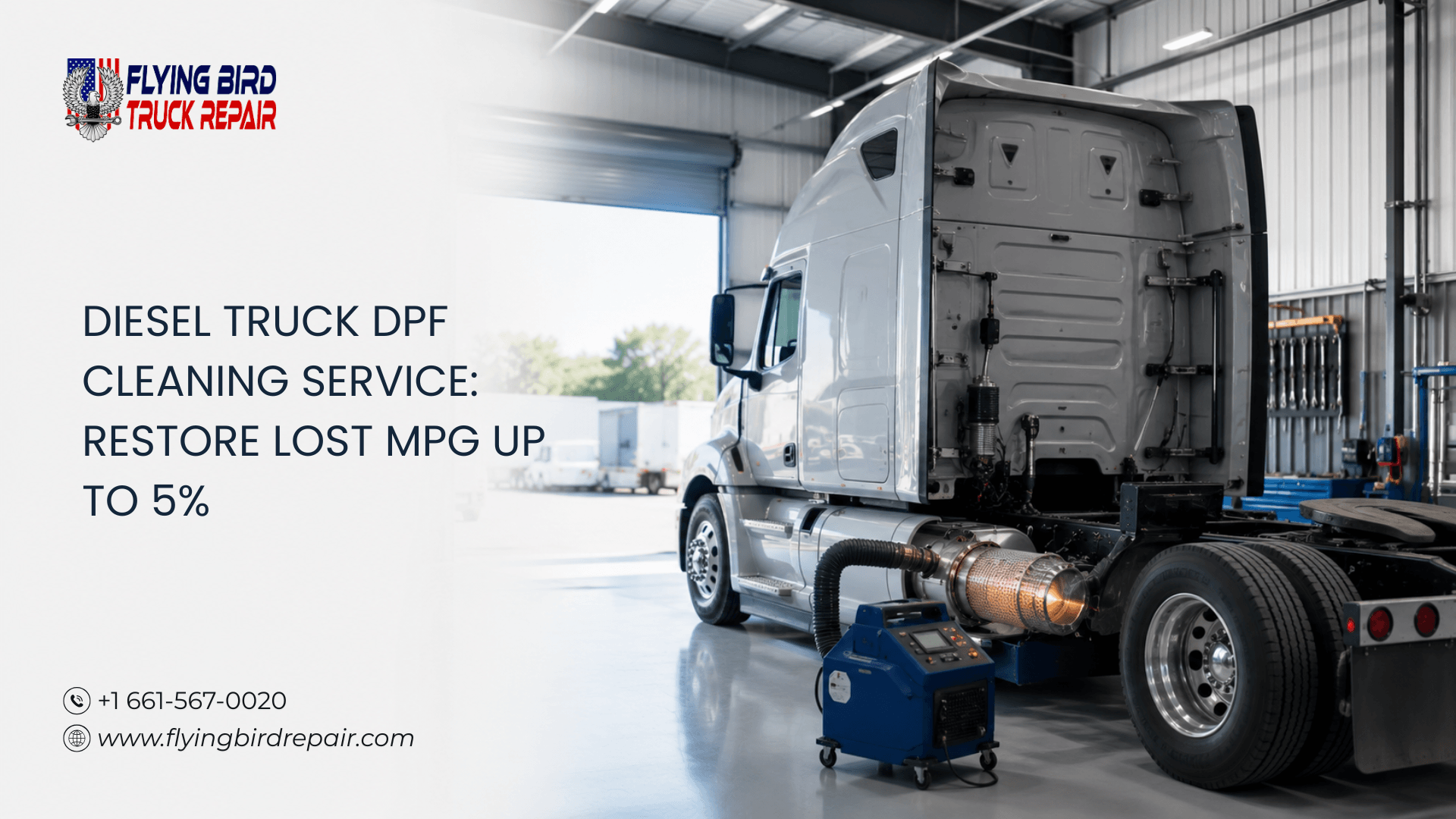
Every mile you run with a clogged DPF is a mile you are paying more for fuel than you have to. At Flying Bird Truck Repair, our team hooks up full diagnostics to assess your filter’s actual soot and ash load, no guesswork. Then we perform a professional bake-and-blow cleaning that removes accumulated ash the regen cycle can never burn off on its own, restoring your filter to like-new airflow and your engine to peak fuel efficiency.
Ignoring the filter only leads to more frequent forced regens, deadhead miles sitting on the side of the road, and eventually an expensive DPF replacement. Don’t let your margins keep shrinking. Pull into our diesel truck repair shop in Bakersfield and let us get your rig running clean.
FAQs Related to DPF Impacting the Economy and Mileage
How do I know if my DPF is clogged or just due for a regen?
If the warning light stays on after a long highway run, regens are happening every 50–100 miles, or power and fuel economy don’t recover after a regen completes, your filter needs a professional cleaning, not another regen.
Can I keep driving with the DPF warning light on?
Technically, yes, but it’s a costly gamble. A solid warning light means the filter is critically loaded. Ignoring it can turn a $300–$500 cleaning into a $3,000–$6,000 replacement if the filter substrate gets permanently damaged.
How long does a professional DPF cleaning take at your Bakersfield shop?
A full bake-and-blow cleaning typically takes a few hours. We run a flow test before and after, so you leave with documented proof that your filter is restored to proper airflow, not just a visual check.
My truck does mostly city driving around Bakersfield. How does that affect my DPF?
City routes are the hardest on a DPF. Frequent idling and short runs prevent passive regen from happening, so soot builds up faster. We recommend inspecting your filter every 50,000-75,000 miles, rather than the standard 100,000-mile interval.
Will cleaning my DPF affect my emissions compliance?
Not at all. Professional DPF cleaning is a manufacturer-recognized maintenance procedure. The filter is cleaned, flow-tested, and reinstalled with zero modifications, your truck stays fully compliant and operates within factory specifications.
How much fuel economy can I realistically recover after a cleaning?
Trucks with heavily loaded filters typically see 5% or more improvement. Even trucks cleaned preventively before symptoms appear see meaningful gains that far outweigh the cost of the service.