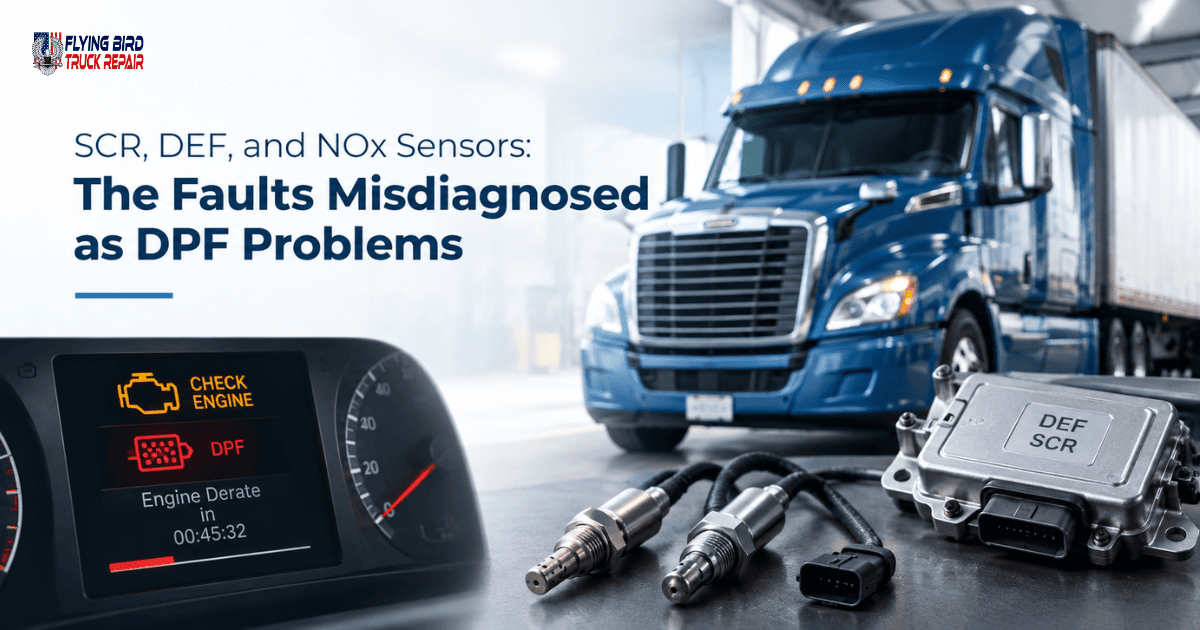
A heavy-duty commercial truck rolls into the shop with an active Check Engine Light, an engine derate counter ticking down, and a dash display flashing a DPF warning. The knee-jerk reaction for many shops is immediate: pull the Diesel Particulate Filter (DPF), run a forced regeneration, or send the ceramic substrate out for a $500 to $1,500 thermal bake.
When the truck leaves the bay and triggers another derate 150 miles down Interstate 5 or Highway 99, the real problem becomes obvious: the DPF wasn’t clogged. The true culprit was a false reading from an upstream Selective Catalytic Reduction (SCR) fault, a drifted Nitrogen Oxide (NOx) sensor, or a failed Diesel Exhaust Fluid (DEF) dosing unit.
At Flying Bird Truck Repair Inc. in Bakersfield, CA, our shop mechanics troubleshoot heavy-duty emission systems using data-driven, diagnostic workflows. Misdiagnosing SCR and DEF issues as physical DPF clogging costs fleet managers and owner-operators thousands of dollars in unnecessary filter cleanings, wasted shop hours, and severe highway downtime.
How SCR and DPF Systems Interact
To avoid misdiagnosis, you must understand how the Engine Control Module (ECM) manages the aftertreatment system as a connected loop.
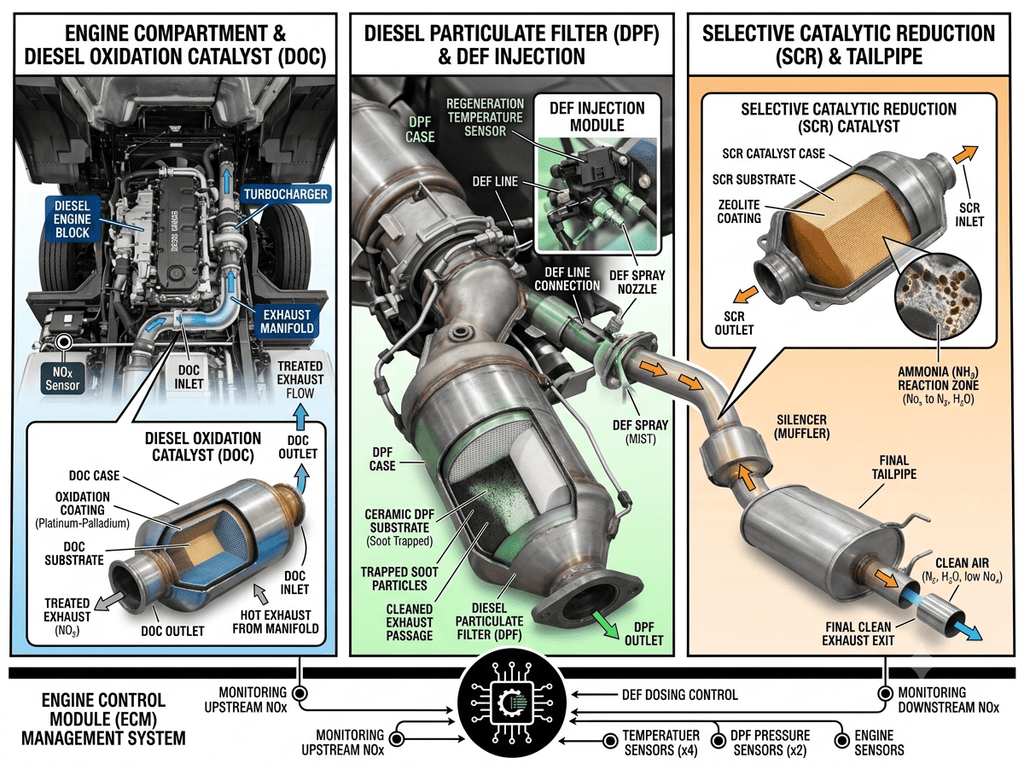
Diesel Oxidation Catalyst (DOC) & DPF: The DOC converts raw hydrocarbons and NO into NO2. The DPF physically traps unburned soot particles. Soot oxidizes passively at high exhaust gas temperatures (>500∘F) or actively during fuel-dosed regenerations (>1,050∘F). If you are experiencing physical soot buildup, explore our specialized DPF Cleaning Services for complete thermal baking and flow restoration.
Selective Catalytic Reduction (SCR): Downstream of the DPF, the SCR system targets harmful NOx gases. The DEF injector sprays a fine mist of 32.5% aqueous urea (DEF) into the hot exhaust stream. The urea decomposes into ammonia (NH3), reacting inside the SCR catalytic converter to turn NOx into harmless nitrogen gas (N2) and water vapor (H2O).
Closed-Loop Sensing: Dual NOx sensors monitor NOx levels before and after the SCR catalyst. The ECM uses these readings, alongside differential pressure sensors (ΔP) and Exhaust Gas Temperature (EGT) sensors, to dynamically adjust DEF injection rates and calculate passive soot oxidation in the DPF.
When a NOx sensor drifts out of calibration or a DEF dosing injector gets plugged with urea crystals, the closed-loop calculation breaks down. The ECM misinterprets incomplete emissions reduction as a failure in thermal regeneration, misdiagnosing the problem as a clogged DPF.
Top 4 SCR and DEF Faults Misdiagnosed as DPF Clogging
Fault 1: Drifted Downstream NOx Sensor (False High NOx Output)
- The Symptom: The engine repeatedly requests active DPF regenerations, but the soot load indicator fails to drop, eventually triggering an active engine derate.
- The Misdiagnosis: Technicians assume the DPF honeycomb is face-plugged or packed with unburnable fuel ash.
- The Real Mechanism: NOx sensors use a ceramic Zirconia element powered by an internal heating element (2–6Ω cold resistance). Over time, exhaust contamination causes the downstream sensor to read higher NOx levels than are actually present (>50 ppm output when true exhaust output is <15 ppm). The ECM assumes the SCR catalyst isn’t reducing emissions because exhaust temperatures are too low. It initiates continuous, high-temperature active DPF regens to heat up the exhaust stack.
- Diagnostic Proof: Perform a cold-start diagnostic sweep using Cummins Insite, Detroit DDDL, or PACCAR Davie4. On a cold engine before NOx reduction begins, both the upstream and downstream NOx sensors should read nearly identical raw NOx values. If the downstream sensor reads significantly higher during a cold idle, the sensor element has drifted and must be replaced. For step-by-step scanner isolation, refer to our Commercial Truck Diagnostics Guide.
Fault 2: Crystallized DEF Dosing Valve (P2047 / SPN 3361)
- The Symptom: Active fault codes trigger an SCR efficiency warning, accompanied by frequent regeneration aborts and sudden engine power loss.
- The Misdiagnosis: Technicians diagnose high exhaust backpressure and assume the DPF filter substrate has melted or collapsed internally.
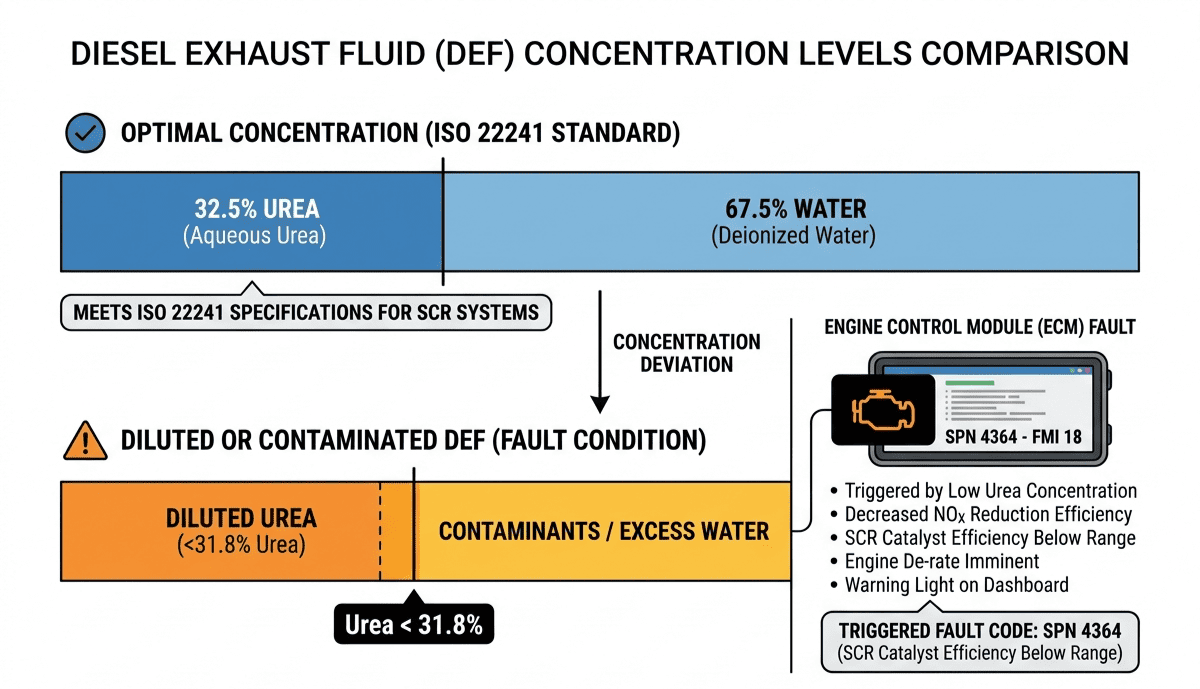
- The Real Mechanism: Operating under light engine loads or frequent stop-and-go driving prevents exhaust gas temperatures from reaching the 392∘F threshold needed for complete urea vaporization. Instead of atomizing, DEF pools and turns into solid white urea crystals around the injector nozzle tip and inside the decomposition tube. This physical restriction blocks the DEF spray pattern. Without proper urea atomization, NOx reduction drops below acceptable limits, triggering efficiency codes (SPN 4364 / P20EE) that mimic aftertreatment flow restrictions.
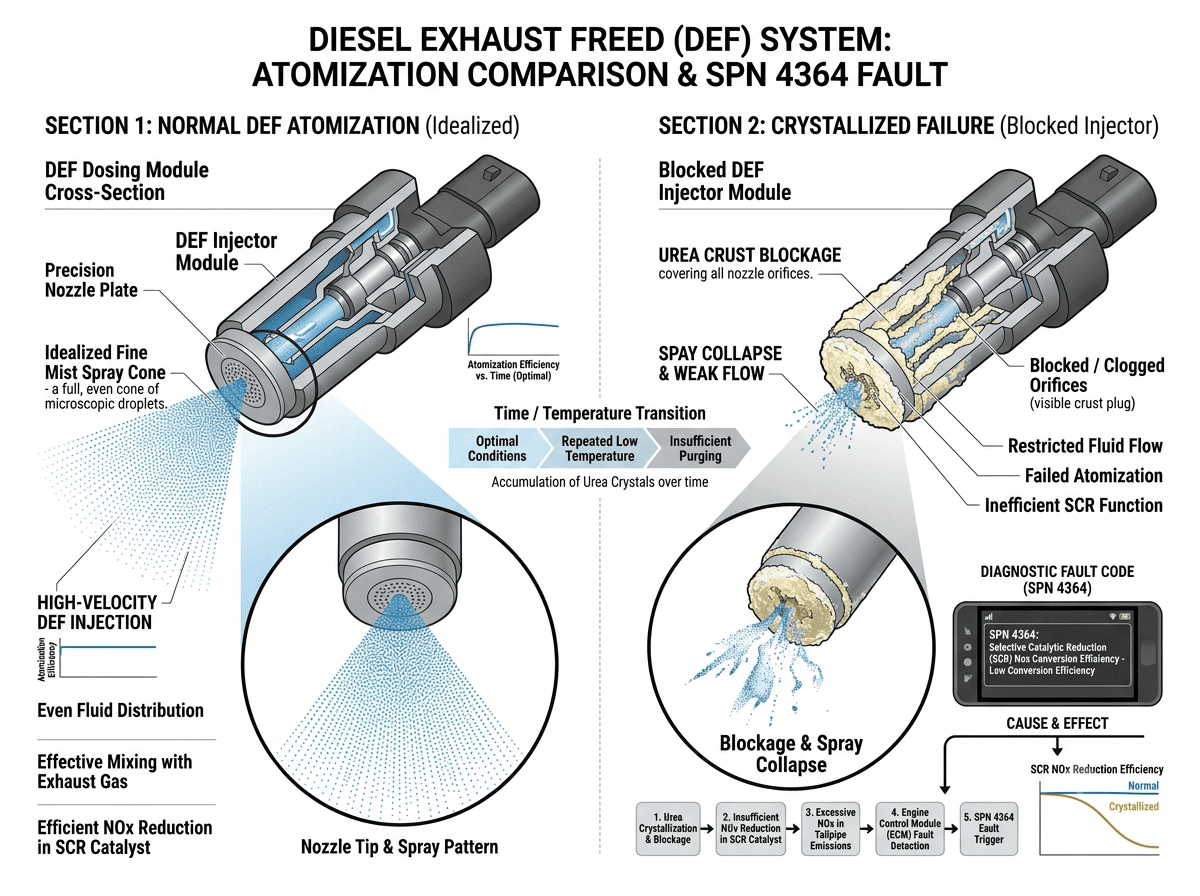
Diagnostic Proof: Remove the DEF injector from the decomposition pipe without disconnecting the fluid lines. Run an automated DEF Dosing Spray Test via your diagnostic scan tool. Observe the spray pattern: it should produce a uniform, conical vapor mist.
If it drips, squirts unevenly, or displays crusty white deposits, clean the nozzle tip with warm distilled water or replace the injector. If an active derate strikes while hauling freight on the highway, our 24/7 Mobile Truck Roadside Assistance team can perform on-site dosing tests and clears.
Fault 3: Contaminated or Degraded DEF Fluid (SPN 4364 / P20EE)
- The Symptom: The truck displays a persistent Check Engine Light with SCR Efficiency Below Threshold codes, even after installing a freshly cleaned DPF.
- The Misdiagnosis: The shop assumes the DPF thermal bake failed or the SCR catalyst substrate is permanently poisoned.
- The Real Mechanism: DEF requires an exact mix of 32.5% high-purity urea and 67.5% deionized water (ISO 22241). Contaminants like tap water, fuel, or dirt disrupt the chemical reaction. Any urea concentration outside the 31.8%-33.2% range severely reduces NOx reduction and causes catalyst crystallization.
- Diagnostic Proof: Do not rely solely on the onboard sensor. Draw a fluid sample from the middle of the tank and test it with an optical refractometer. If the reading falls outside 31.8%-33.2%, drain, flush, and refill the tank with certified DEF before replacing any hardware.
Fault 4: CAN Bus Wiring Harness Chafing (SPN 3226 / P220B)
- The Symptom: The dash displays intermittent aftertreatment fault codes, unpredictable 5 mph derate warnings, and erratic sensor readings that disappear after cycling the key.
- The Misdiagnosis: Replacing functional DPF differential pressure sensors or tearing down the exhaust manifold to check for leaks.
- The Real Mechanism: Heavy-duty commercial trucks operating along rough highway corridors suffer from frame rail vibration. The smart NOx sensor control module, mounted directly to the frame rail—relies on a high-speed CAN Bus network (250/500 kbps) to send telemetry to the ECM. Wire chafing against heat shields or pin corrosion inside the unsealed harness connector causes brief drops in CAN communication (120Ω node resistance checks). The ECM interprets this momentary data loss as an active emissions failure, locking the truck into a safety derate mode.
Master Diagnostic Matrix: Fault Code Breakdown
When troubleshooting aftertreatment codes on Cummins ISX/X15, Detroit DD15, or PACCAR MX-13 engines, use this reference table before removing the DPF:
| Active DTC / SPN | Code Description | Primary Root Cause | Fast Verification Method |
| SPN 3216 / P220A | Upstream NOx Sensor Circuit Open / Short | Blown sensor heater circuit fuse or burnt internal element. | Measure supply voltage at harness pin (~12–24V) & heater resistance ($2\text{–}6\,\Omega$). |
| SPN 3226 / P220B | Downstream NOx Sensor Communication Lost | Chafed wiring along frame rails or oxidized connector pins. | Test CAN-H to CAN-L resistance across harness ($60\,\Omega$ parallel / $120\,\Omega$ per node). |
| SPN 4364 / P20EE | SCR Catalyst Conversion Efficiency Below Threshold | Diluted DEF fluid, drifted downstream NOx sensor, or bad dosing valve. | Test DEF sample with optical refractometer (target: 32.5% urea) & compare NOx ppm delta. |
| SPN 3361 / P2047 | Reductant Dosing Valve Circuit / Flow Fault | Crystallized urea clogging nozzle tip or shorted solenoid coil. | Perform automated software DEF Quantity/Spray Test & inspect nozzle tip physically. |
| SPN 3251 / P24A0 | DPF Differential Pressure ($\Delta P$) Too High | Actual soot accumulation OR moisture-blocked sensor lines. | Inspect sensor steel tubes for ice, soot crust, or melted rubber pressure hoses. |
Professional 4-Step SCR & NOx Troubleshooting Workflow
To eliminate guesswork and stop replacing good parts, follow this structured shop procedure:
Step 1: Freeze Frame & Active DTC Analysis
Connect OEM diagnostic software (Cummins Insite, Detroit DDDL, PACCAR Davie4). Pull active, pending, and historic fault codes. Record freeze frame data before clearing any codes. Look specifically at:
- Exhaust Gas Temperature (EGT) sensor outputs across all positions.
- DPF differential pressure (ΔP) in kilopascals (kPa) or inches of water (in. H2O).
- DEF dosing rate (g/hr) and engine load percentage at the exact moment the fault occurred.
Step 2: DEF Fluid Quality Refractometer Test
Draw a fluid sample directly from the core of the DEF tank using a sampling thief.
- Clean the glass prism of an optical refractometer with distilled water and wipe dry.
- Place 2–3 drops of DEF on the prism and close the cover plate.
- Look through the eyepiece under direct light. The light/shadow boundary line must rest squarely on 32.5%.
- If the fluid reads below 31.8% or above 33.2%, flush the tank. Do not proceed with component testing until fluid purity is restored.
Step 3: Live Sensor Delta & Efficiency Calculation
Start the engine and bring the exhaust temperature above the SCR activation threshold (>400∘F/204∘C). Monitor live data channels for upstream raw NOx and downstream tailpipe NOx.
- Upstream NOx Sensor: Should fluctuate actively based on throttle load (150–450 ppm).
- Downstream NOx Sensor: Should stay flat and low (<30 ppm) on a healthy SCR catalyst.
- Calculate SCR Conversion Efficiency:
SCR Efficiency (%)=(1−NOxUpstreamNOxDownstream)×100 - Pass/Fail Criterion: If calculated conversion efficiency falls below 85% while exhaust temps are above 400∘F and DEF fluid is verified at 32.5%, the system has an active SCR or sensing fault.
Step 4: Electrical Pinout & Physical Spray Check
If electrical circuit codes (SPN 3216/3226) are present:
- Disconnect the NOx sensor harness connector.
- Set your digital multimeter (DMM) to DC Volts and verify main battery power feed between Pin 1 and Ground (~12V–24V).
- Test Ground Pin continuity back to the chassis frame—resistance must measure less than 0.5Ω.
- Check CAN-High to CAN-Low pin resistance across the unpowered harness. A reading of 60Ω verifies both 120Ω termination resistors are intact on the bus.
Preventative Maintenance to Avoid False DPF Failures
- Service Turbo Seals and EGR Coolers Promptly: Internal oil or coolant leaks carry over into the exhaust stream. Burning engine oil deposits phosphorus and zinc on the SCR catalyst face, permanently poisoning the precious metals and ruining NOx conversion.
- Stay Compliant During Inspections: Unresolved emission fault codes and active derates are primary triggers for out-of-service violations during routine CHP safety audits. Review our guide on California 90-Day BIT Inspections to maintain total fleet compliance.
- Execute Mandatory ECM Reset Protocols After Sensor Replacement: Replacing a NOx sensor or DEF dosing valve without recalibrating the ECM will cause immediate repeat codes. Always run the automated software procedures:
- SCR Efficiency Reset
- NOx Sensor Adaptation / Trim Reset
- DEF Doser Reset
- Keep Exhaust Temps High Under Heavy Loads: Extended engine idling causes DEF crystallization in the decomposition tube. Drivers should minimize unnecessary idling and run higher duty-cycle routes to allow natural passive oxidation to keep the aftertreatment system clean.
Fast Diagnostic & Repair Services in Bakersfield, CA
Troubleshooting heavy-duty diesel emission systems requires specialized diagnostic tools and technician experience. At Flying Bird Truck Repair Inc., our certified shop mechanics combine computer diagnostics with hands-on repair to fix the root cause of your emission problems, saving you time and money.
- Location: 681 Pepper Dr, Bakersfield, CA 93307
- Services: 24/7 Roadside Assistance, DPF Cleaning, SCR/DEF Diagnostics, 90-Day BIT Inspections, Mobile Truck Repair
- Corridors Served: Bakersfield, Kern County, Interstate 5, Highway 99, Highway 58
- Need Fleet Staging or Parking? If your vehicle is waiting on aftertreatment parts, take advantage of our secure, gated Commercial Truck Parking Facilities in Bakersfield.
Technical Aftertreatment FAQ
Can a failed downstream NOx sensor cause a false DPF soot load reading?
Yes. The Engine Control Module (ECM) uses downstream NOx readings to verify that active regeneration is successfully burning off soot. If a downstream sensor drifts high, the ECM assumes the regeneration failed, locks out further passive oxidation, and inflates the calculated DPF soot load value, triggering an unnecessary forced regen or derate.
How do I tell if my SCR catalyst is poisoned or if I just have a bad NOx sensor?
Check sensor ppm readings on a completely cold engine prior to starting. Because NOx gases are only produced during high-temperature combustion, both upstream and downstream sensors should read 0 ppm under key-on, engine-off conditions. If a sensor reads 25 ppm or higher on a cold engine, the sensor itself has failed internally. If both sensors read 0 ppm cold, but downstream NOx remains high during hot operation despite proper DEF dosing, the SCR catalyst is degraded or chemically poisoned.
Why does my truck continue to display an active 5 mph derate after I installed a clean DPF?
Cleaning the physical DPF filter does not clear software-based emission derate counters inside the ECM. According to the U.S. EPA Clean Air Act Diesel Enforcement Guidelines, heavy-duty engine software mandates non-clearable derates for active emissions violations until a successful SCR System Health Test or Drive Cycle Verification is completed using OEM software.