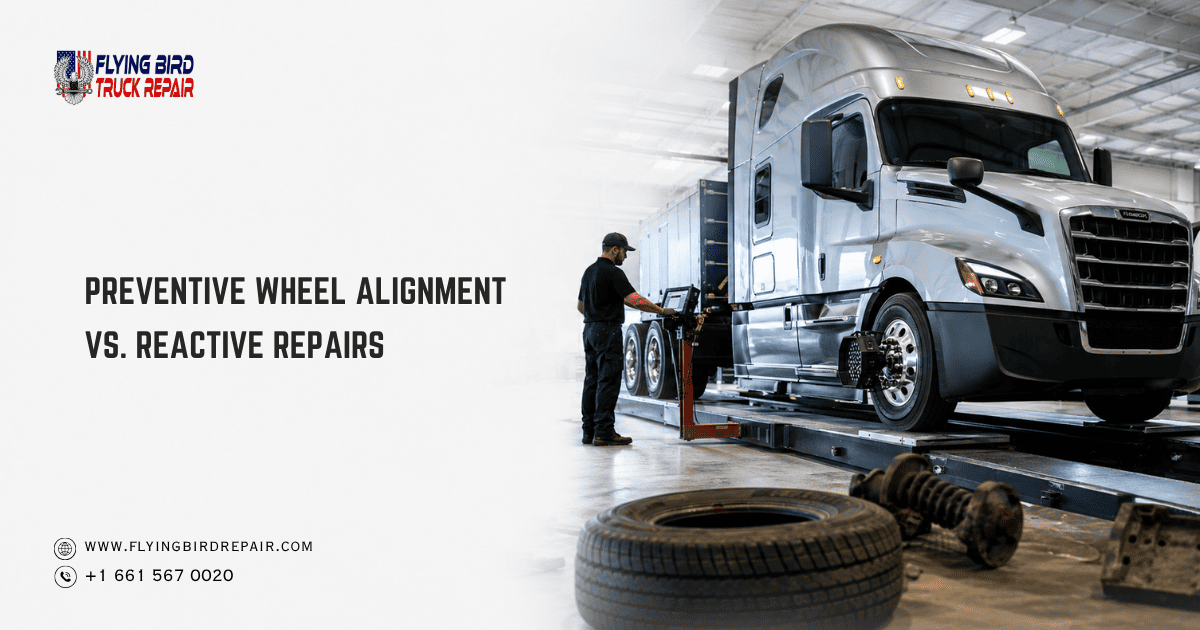
Every fleet manager eventually faces the same choice: invest in routine wheel alignment before problems appear, or deal with repairs after the damage is done. One feels like an expense. The other feels like a risk. But when you run the actual numbers — tires, fuel, downtime, and suspension wear- only one of these approaches holds up financially.
In this post, we put preventive wheel alignment and reactive repairs side by side across every major cost category, so you can see exactly which strategy protects your fleet’s bottom line, and by how much.
What Wheel Alignment Actually Means for Heavy-Duty Trucks
Before the comparison, let’s establish what’s at stake. Wheel alignment refers to the precise angles and directions at which your truck’s tires contact the road. Three key measurements determine this:
- Toe – whether tires point inward or outward relative to the vehicle’s centerline
- Camber – the vertical tilt of the tire when viewed from the front
- Caster – the angle of the steering axis, affecting stability and steering return
For passenger vehicles, minor misalignment is manageable. For commercial trucks, the consequences are significantly amplified. Heavy loads worsen with every degree of misalignment. Constant highway miles accelerate wear. Potholes, curb strikes, and uneven loading can knock wheels out of spec with no visible warning.
The core problem is that alignment drifts gradually, and most fleets don’t check it until a symptom forces their hand. By that point, the reactive base is already losing the cost battle.
Side 1: The Reactive Approach: What “Wait and Fix” Really Costs
Reactive fleet management means responding to alignment problems after they’ve already caused damage. On the surface, it looks like saving money by skipping routine services. In practice, it means paying far more, far less predictably. Here’s where those costs accumulate:
Premature Tire Replacement
Commercial truck tires cost $400 to $ 600 or more each. Misalignment causes uneven tread wear, reducing tire lifespan by 20,000 to 30,000 miles. For a 10-truck fleet, that can mean replacing tires 1–2 full cycles earlier per year: a cost that stacks up fast.
Excess Fuel Consumption
Misaligned wheels increase rolling resistance, forcing your engine to work harder on every mile. This reduces fuel efficiency by 3–7%. For a truck covering 100,000 miles annually, that’s a substantial volume of diesel burned with nothing to show for it.
Suspension and Drivetrain Damage
Persistent misalignment stresses tie rods, wheel bearings, ball joints, and steering components. These aren’t inexpensive parts, and they often fail without warning, converting a routine delivery run into a costly roadside breakdown.
Unplanned Downtime
Reactive repairs typically sideline a truck for 1–3 days. Every hour off the road means missed loads, rescheduled deliveries, and idle drivers. That downtime carries a real dollar cost that rarely appears on the maintenance invoice but always shows up on the bottom line.
Safety and Liability Exposure
A truck that pulls, vibrates, or handles unpredictably is a liability risk. Accidents related to poor vehicle handling can result in costs that dwarf any maintenance budget, reactive or otherwise.
Side 2: The Preventive Approach: What a Routine Alignment Actually Buys You
Semi-truck wheel alignment costs in the USA typically range from $200 to $600, depending on the number of axles, the severity of the misalignment, and labor rates. That single service simultaneously protects your tires, stabilizes fuel economy, reduces suspension stress, and keeps your truck operating on schedule.
Most high-mileage commercial fleets benefit from two alignment checks per year, a total investment of approximately $300–$600 per truck. That one number covers what the reactive approach pays across tires, fuel waste, parts, and downtime in a single bad event.
What preventive alignment protects:
- Full tire lifespan: no premature replacement cycles
- Optimized fuel consumption: no excess rolling resistance
- Suspension integrity: no accelerated wear on bearings and joints
- Scheduled downtime: 1–2 hours planned, not 1–3 days unplanned
- Driver safety: consistent, predictable handling on every route
Beyond the direct alignment cost savings, a preventive schedule gives you something reactive management never can: predictability. You can budget for alignment checks. You cannot budget for a blown tire on a highway run at midnight.
Warning Signs Your Fleet Is Already on the Reactive Side
If your trucks are showing any of these symptoms, alignment damage is already underway, and every additional mile is widening the repair bill:
- Uneven or accelerated tire wear on one side or edge of the tread
- Truck drifting or pulling left or right on a straight, flat road
- Steering wheel sitting off-center when driving straight
- Vibration in the steering column at highway speeds
- Fuel consumption rising with no change in load or route
- Squealing tires during normal turns at regular speeds
How to Switch Your Fleet to the Preventive Side
Making the shift doesn’t require a major overhaul. A straightforward alignment schedule is enough to move the needle:
- Every 25,000–50,000 miles for high-mileage highway trucks
- Every 6 months for urban delivery trucks with frequent curb exposure
- After any significant road incident — pothole strike, curb impact, or collision
- Whenever new tires are installed — alignment determines how long those tires last
- At each seasonal transition when road surface conditions shift significantly
Pairing alignment checks with routine services, such as tire rotations, brake inspections, and oil and filter changes, reduces shop visits and keeps your fleet on a consistent, manageable maintenance cycle.
For multi-truck operations, maintaining a simple per-vehicle alignment log also helps flag trucks that drift out of spec faster than normal, which can indicate a deeper suspension issue worth catching early.
Every Mile Misaligned Is Money Left on the Road
Preventive wheel alignment isn’t an extra expense; it’s what keeps your fleet profitable, your tires lasting, and your trucks moving. Every delayed check quietly inflates your operating costs in ways most fleet managers don’t catch until the damage is done.
At Flying Bird Truck Repair, we specialize in keeping commercial fleets aligned, efficient, and road-ready, with fast turnarounds that respect your schedule and your bottom line.
Don’t wait for your trucks to tell you something’s wrong. Contact Flying Bird Truck Repair today and schedule our truck tire alignment services in Bakersfield.
Frequently Asked Questions
How often should a commercial truck get a wheel alignment?
Every 25,000 to 50,000 miles is the standard baseline for highway trucks. Urban delivery vehicles may need checks every 6 months due to more frequent curb exposure. Always align after a road incident or when installing new tires.
Can misalignment cause a truck to fail a DOT inspection?
Yes. Excessive or uneven tire wear resulting from misalignment can trigger out-of-service violations. Staying aligned is a core part of keeping your fleet inspection-ready.
Does wheel alignment affect fuel economy on heavy-duty trucks?
It does. Misaligned wheels increase rolling resistance, which forces the engine to burn more diesel over every mile. Even modest misalignment can cut fuel efficiency by 3–7%, a meaningful figure across a full fleet running high annual mileage.
How long does a commercial truck alignment take?
A standard check and adjustment runs 1–2 hours. That compares favorably to 1–3 days of unplanned downtime when a reactive repair becomes unavoidable.
Is alignment covered under fleet maintenance contracts?
It varies. Many agreements can include periodic alignment checks when requested. Ask your service provider about bundling alignment into your existing schedule to reduce per-visit costs.
What is the difference between wheel alignment and wheel balancing?
Alignment corrects the angles at which tires meet the road. Balancing addresses uneven weight distribution around the wheel and tire assembly. Both affect wear and ride quality but are separate services that should be checked independently.