A check engine light is never good timing. But when it shows up alongside rough idling, black smoke, and a sudden drop in fuel economy, the EGR valve is usually the first place worth checking.
Most drivers think about this part only when something breaks. That’s the expensive way to learn. A stuck or carbon-choked EGR valve doesn’t just hurt performance; it quietly loads up your DPF, forces constant regens, and can put your rig into limp mode at the worst possible moment.
This guide covers the real causes, the exact fault codes, the hard repair costs, and when professional diesel truck repair is the smarter call over a DIY fix.
What the EGR Valve Does and Why It Chokes
The EGR (Exhaust Gas Recirculation) valve has one primary job: to reduce harmful nitrogen oxide (NOx) emissions by recirculating a measured portion of exhaust gas back into the engine’s intake manifold. This lowers peak combustion temperatures, which is the main mechanism that limits NOx production in diesel engines.
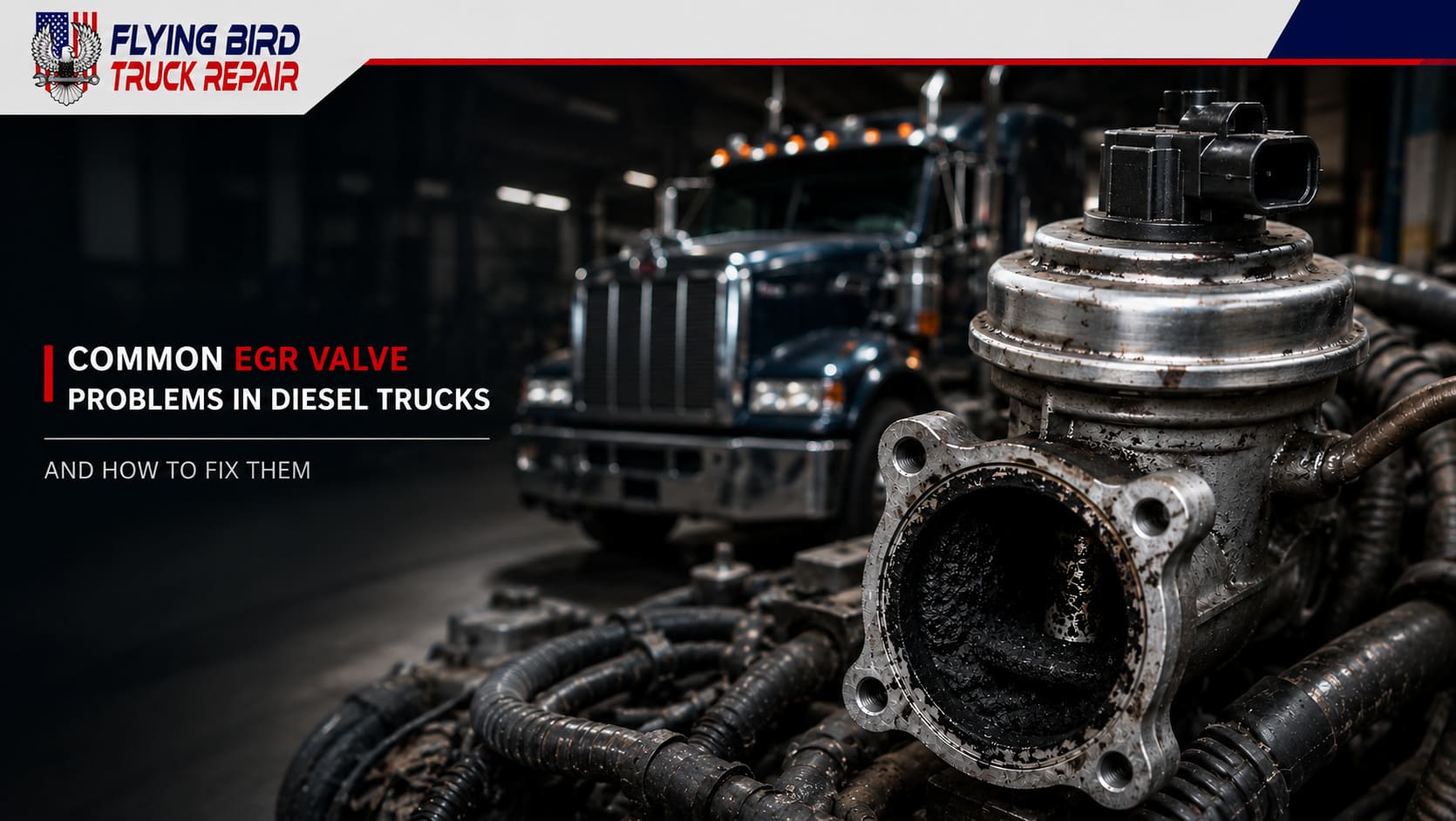
Here’s the problem. Diesel exhaust isn’t clean. It carries soot, unburned fuel particles, and sticky carbon deposits. Every time the valve cycles open to recirculate the exhaust, a thin layer of that material coats the valve seat, pintle, and actuator mechanism. Over thousands of miles, those thin layers turn into thick, baked-on carbon deposits that gradually prevent the valve from opening or closing properly.
The result is an EGR valve that is either stuck open, stuck closed, or moving sluggishly between the two, and each scenario causes its own set of problems.
The Six Most Common EGR Valve Problems in Diesel Trucks
- Carbon Buildup and Clogging
The most frequent issue by a wide margin. Heavy carbon deposits reduce or completely block the flow of exhaust gas through the valve. The ECM detects the restricted flow and triggers fault codes, most commonly a P0401 (EGR Flow Insufficient Detected) or P0400 (EGR Flow Malfunction). Left untreated, the hardened carbon will eventually completely seize the valve.
- Valve Stuck in the Open Position
When the EGR valve stays stuck open, exhaust gas floods the intake at all times — including at idle, when it should not be entering. This creates an overly rich, oxygen-starved combustion environment. Drivers typically notice rough idling, stalling at low RPM, and a significant loss of power under load.
- Valve Stuck in the Closed Position
A valve that refuses to open stops exhaust recirculation entirely. The engine runs hot, NOx emissions spike, and a P0401 code is usually the first sign. While the truck may still drive, it will fail any emissions compliance check and subject the entire emissions system to additional thermal stress.
- EGR Cooler Failure
The EGR cooler lowers exhaust gas temperature before it returns to the intake. If the cooler cracks or leaks, coolant can enter the intake or exhaust, causing white smoke, coolant loss, overheating, and poor performance. In severe cases, it can cause major engine damage, so prompt inspection and repair are essential.
- Electrical Actuator Failure
Modern EGR valves use an electronic actuator (a small motor or solenoid) to control valve movement in response to ECM signals. When the actuator fails, the ECM loses control of the valve’s position entirely. This shows up as codes P0403 (EGR Control Circuit Malfunction) or P0404 (EGR Control Circuit Range/Performance) and often requires full valve replacement rather than cleaning.
- Excessive Soot from Short-Trip Driving
Trucks that run local routes, idle frequently, or make short delivery runs never sustain the high exhaust temperatures needed to burn off carbon naturally. This accelerated soot buildup is why two trucks with the same engine and mileage can have completely different EGR lifespans.
Symptoms Drivers Notice First
Before any fault code triggers, the truck usually starts sending signals through its driving behavior. Here is what to watch for:
- Rough idle or stalling at low RPM.
- Noticeable power loss on grades or under heavy load.
- Drop in fuel economy with no obvious explanation.
- Thick black exhaust smoke from the stacks.
- Stationary regens are happening more frequently than usual.
- Check engine light showing fault codes P0400, P0401, P0402, P0403, or P0404.
For fleet managers, these are the exact complaints to train drivers to report immediately. Catching an EGR issue at the symptom stage is dramatically cheaper than waiting for the DPF to fail.
The Domino Effect: Why Ignoring This Gets Expensive Fast
An EGR valve problem never stays contained to just the EGR valve.
Here is the chain reaction:
- A stuck or dirty EGR valve increases soot production.
- Excess soot travels downstream and rapidly clogs the Diesel Particulate Filter (DPF).
- A clogged DPF forces the truck into frequent active regens to burn off the accumulation.
- Constant forced regens create extreme heat cycles that accelerate wear on the turbocharger and exhaust system.
- If regens cannot keep up with the soot load, the ECM triggers limp mode, the truck is limited to roughly 5 mph, and goes nowhere until the fault is cleared.
On a Cummins X15 or Detroit DD15, a neglected EGR valve that causes a cascading DPF and turbo failure can result in a combined repair bill of $8,000 to $15,000 or more. EGR valve cleaning or replacement, which could have stopped it at step one, typically costs a fraction of that.
Cleaning vs. Replacement: Hard Costs Broken Down
Not every failing EGR valve needs to be replaced. Here is how to decide:
| Condition | Recommended Service | Estimated Cost |
| Carbon buildup, valve hardware intact | Professional ultrasonic cleaning | $150 – $400 |
| Minor buildup that can be addressed in-bay | Professional spray/soak cleaning | $80 – $200 |
| Damaged actuator or seized mechanism | Full valve replacement | $1,500 – $3,500+ |
| The EGR cooler is also leaking or cracked | Valve + cooler replacement | $2,500 – $5,000+ |
A word of caution: cheap spray solvents from auto parts stores rarely remove baked-on carbon effectively. Worse, they can destroy delicate internal sensors and actuator components. Professional shops that repair trucks use ultrasonic cleaning tanks that break down carbon at the molecular level without damaging the valve’s electronics. When in doubt, invest in a professional diagnostic before attempting any cleaning.
Preventive Maintenance Intervals by Duty Cycle
The single biggest factor in EGR valve lifespan is how the truck is used. Use these intervals as your baseline:
| Duty Cycle | Recommended EGR Cleaning Interval | Reason |
| Long-haul / OTR highway | Every 40,000 – 50,000 miles | Sustained high exhaust temps burn off soot naturally. |
| Mixed regional (highway + city) | Every 25,000 – 35,000 miles | Moderate temp variation accelerates carbon deposits. |
| Local delivery / stop-and-go | Every 15,000 – 25,000 miles | Low sustained temps allow rapid carbon accumulation. |
| Port/yard / severe idling | Every 10,000 – 15,000 miles | Constant low-load operation causes the fastest buildup. |
For fleet managers, building these intervals directly into your PM schedule, just like oil changes and tire rotations, is the most cost-effective way to eliminate emissions-related downtime.
Engine-Specific Notes: Cummins, Detroit, and PACCAR
Different engine platforms have slightly different EGR system layouts, which affects both how they fail and how long they take to repair.
- Cummins ISX / X15: High-volume EGR systems that are particularly vulnerable to carbon buildup in the EGR cooler tubes. Fault codes P0401 and P0488 are common. Plan for 3–5 hours of labor on a full replacement.
- Detroit DD13/15: EGR systems that sit in tight bays, making access difficult. Coolant-related failures (e.g., cracked EGR cooler) are more frequent on high-mileage DD15 engines.
- PACCAR MX-11 / MX-13: Known for electronic actuator sensitivity. When the actuator starts to fail, fault code P0403 appears early, before the valve is fully seized, indicating earlier intervention is more realistic on these platforms.
Get It Diagnosed Before It Gets Worse
If your truck is throwing a P0401 code, idling rough, or burning through fuel faster than usual, the EGR system is worth checking before it takes your DPF with it. Flying Bird Truck Repair handles everything from quick diagnostics to ultrasonic EGR cleaning and full valve replacements on Cummins, Detroit, and PACCAR engines. Honest assessments. Fast turnarounds. No unnecessary upsells.
Call us today or stop by our expert truck repair in Bakersfield, and we’ll tell you exactly what it needs.
Frequently Asked Questions
Can I drive with a bad EGR valve?
Short distances in an emergency, yes. Long term, absolutely not. A stuck EGR valve will accelerate soot loading into your DPF, trigger constant forced regens, and can put your truck into limp mode at the worst possible time. The longer you wait, the more systems get affected.
Will cleaning fix a P0401 code?
In many cases, yes, especially if the valve is mechanically intact but restricted by carbon buildup. However, if the fault code is accompanied by P0403 or P0404, the actuator or wiring may also require attention. A proper diagnostic read before cleaning will confirm whether cleaning alone will clear the fault.
How long does an EGR valve replacement take?
Most professional mechanics complete a straightforward valve replacement in 3 to 5 hours. If the EGR cooler must also be removed, inspected, or replaced, budget for 6 to 8 hours of labor, depending on the engine platform.
Why is my fleet seeing frequent DPF regens across multiple trucks?
If multiple trucks in your fleet are experiencing premature DPF clogging and frequent regens, the common upstream culprit is usually the EGR valve. It is worth scheduling an EGR system inspection across the fleet rather than replacing DPFs one by one without addressing the root cause.
How much does it cost to replace a DPF if I ignore the EGR issue?
A DPF replacement on a Class 8 truck typically costs between $2,500 and $5,500 for the filter alone, not including labor or additional repairs to emissions components. Compared to an EGR cleaning costing $150–$400, the math is straightforward.