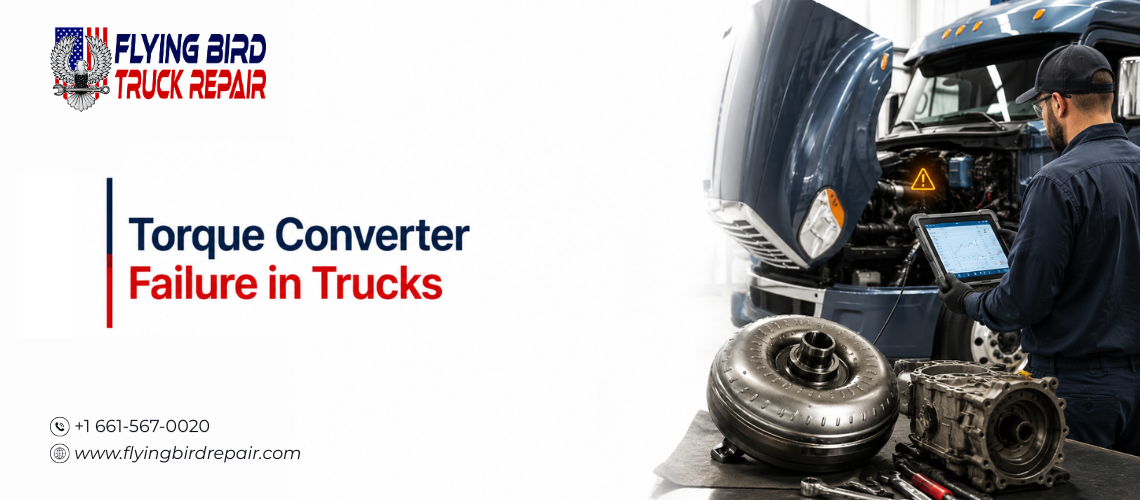
Whether you’re hauling a heavy load or merging onto the highway, a sudden shudder is a major red flag. When your engine RPMs spike, but your rig barely moves, you’re likely facing a failing torque converter.
For owner-operators and fleet managers, ignoring these symptoms is a gamble that leads to catastrophic downtime. Because a faulty converter can quickly send metal debris throughout your drivetrain, a professional truck diagnostic service is essential to catch the issue before it turns a targeted repair into a total transmission rebuild. In this guide, Flying Bird Truck Repair breaks down how to identify torque converter failure, what causes it, and the best steps to keep your truck on the road.
What Does a Torque Converter Actually Do in a Truck?
In an automatic transmission truck, the torque converter serves as the vital hydraulic bridge between the engine and the transmission. In simpler terms, it does the job of a clutch in a manual transmission. It allows your engine to keep running while the truck is stopped and multiplies torque when you accelerate from a dead stop to get heavy loads moving.
Modern heavy-duty trucks also rely on a lock-up clutch inside the converter. At cruising speeds, this clutch mechanically links the engine and transmission, eliminating hydraulic slip. This improves fuel efficiency and keeps operating temperatures in check. When any part of this system fails, your truck’s ability to transfer power effectively is instantly compromised.
Warning Signs Your Truck’s Torque Converter Is Failing
Torque converters are sealed inside the bell housing, meaning you cannot visually inspect them. You must rely on how the truck feels, sounds, and drives. Watch out for these primary red flags.
The 35-to-45 MPH Shudder
Often called the “torque converter shudder,” this is the most common symptom of failure. Usually occurring between 35 and 45 mph, it feels exactly like driving over the rumble strips on the shoulder of the highway. This happens when the internal lock-up clutch struggles to engage smoothly, rapidly slipping and grabbing instead of locking into place.
Slipping Gears and High RPMs
If you floor the accelerator and the engine revs aggressively but the truck struggles to gain speed, the converter is failing to transfer hydraulic pressure. This loss of power often indicates that the internal stator or turbine fins are worn or damaged.
Spiking Transmission Temperatures
Heavy-duty trucks generate significant heat, but if your transmission temperature gauge is consistently running hot or pushing past the danger zone, the torque converter is likely slipping excessively. Overheating is both a symptom of a failing converter and a primary cause of further transmission damage.
Contaminated or Burnt Transmission Fluid
Pull your dipstick. Healthy transmission fluid should be bright, cherry red. If it looks dark brown, black, smells like burnt toast, or has a metallic “glitter” to it, your torque converter is literally cooking the fluid and shedding metal shavings into the system.
Unusual Whining or Grinding Noises
A failing needle bearing inside the torque converter will often produce a high-pitched whine or a mechanical grinding noise. If the sound is present when the truck is in gear but disappears when you shift into Neutral or Park, the converter is the prime suspect.
What Causes Torque Converter Failure in Heavy-Duty Trucks?
Trucks operate under extreme conditions. While normal wear and tear plays a role, several specific factors accelerate torque converter breakdown in commercial and heavy-duty applications.
Severe Overheating
Excessive heat is the absolute worst enemy of automatic transmissions. Towing loads past your Gross Vehicle Weight Rating (GVWR) or navigating steep grades in stop-and-go traffic degrades the transmission fluid. Once the fluid loses its cooling and lubricating properties, the internal seals and clutches inside the converter burn up.
Degraded Transmission Fluid
Transmission fluid contains specific chemical friction modifiers that allow the lock-up clutch to operate seamlessly. When routine maintenance is ignored and the fluid ages, these modifiers break down. Without them, the clutch slips, generating the dreaded shudder.
Worn Needle Bearings
Needle bearings separate the rapidly spinning internal components of the converter. Over thousands of miles of heavy hauling, these bearings can wear out and disintegrate, causing metal-on-metal friction and eventual catastrophic failure.
Faulty Torque Converter Clutch (TCC) Solenoid
Sometimes, the mechanical components of the converter are perfectly fine, but the electronic TCC solenoid that controls the hydraulic pressure fails. A bad solenoid will prevent the converter from locking up, leading to high RPMs, excess heat, and poor fuel economy.
What to Do the Moment You Notice These Symptoms
If your truck exhibits any of the signs above, immediate action is required to prevent secondary damage.
- Pull Over and Check the Fluid: Ensure your transmission fluid is topped off and inspect its color and smell. Low fluid can mimic a mechanical failure.
- Stop Towing Heavy Loads: If the converter is slipping, hauling thousands of pounds will push it over the edge. Disconnect the trailer if safely possible.
- Get to a Professional Shop: Do not wait for the problem to resolve itself. It won’t. If you find yourself stranded, Flying Bird Truck Repair offers emergency truck roadside service in Bakersfield to get your rig off the shoulder and into the shop for a proper teardown.
How a Truck Diagnostic Service Identifies Torque Converter Problems
At Flying Bird Truck Repair, we do not guess when it comes to your livelihood. Our technicians use precise diagnostic methods:
- Electronic Diagnostics: We connect advanced scan tools to monitor the exact “slip RPM” commanded by the truck’s computer versus what is actually happening inside the transmission.
- Stall Testing: By safely applying the brakes and the throttle simultaneously under controlled conditions, we measure the maximum RPM the engine achieves. If it falls outside the manufacturer’s specifications, the internal stator is failing.
- Fluid and Pan Inspection: We drop the transmission pan to check for sludge, burnt fluid, and metal debris, giving us a clear picture of the unit’s internal health.
Repair or Replace? What Truck Owners Should Expect
Because a torque converter is a welded, sealed unit, it cannot be opened and repaired while inside the truck.
- TCC Solenoid Replacement: If diagnostics point to an electronic solenoid failure rather than the converter itself, this is a relatively inexpensive fix that does not require dropping the transmission.
- Converter Replacement: If the converter itself is failing but the fluid is clean and free of metal, the transmission can be removed, and a new heavy-duty converter installed.
- Total Rebuild: If the converter has already shattered and contaminated the transmission with metal debris, a complete transmission rebuild or replacement is the only reliable, long-term solution.
Secure Your Truck’s Drivetrain with Flying Bird Truck Repair
When your truck is your business, you can’t afford to let a transmission shudder turn into a shattered drivetrain. At Flying Bird Truck Repair, we specialize in heavy-duty diagnostics and repairs. Our technicians have the heavy-duty lifts, advanced scan tools, and hands-on expertise to accurately diagnose your torque converter right the first time.
Don’t risk a massive rebuild call Flying Bird Truck Repair today to schedule your commercial transmission inspection and keep your rig rolling strong.
FAQs About Torque Convertor Failure in Trucks
Q1: How long does a torque converter last in a truck?
Under normal driving conditions, a torque converter can easily last 150,000 to 200,000 miles. However, trucks used for heavy towing or hotshotting without proper fluid maintenance may see failures as early as 80,000 miles.
Q2: Can low transmission fluid cause torque converter shudder?
Yes. Low fluid reduces the hydraulic pressure required to properly engage the lock-up clutch. Topping off the fluid with the correct specification can sometimes eliminate a minor shudder, though damage may already be done if run low for too long.
Q3: Will a bad torque converter trigger a Check Engine Light?
Most of the time, yes. Modern truck computers constantly monitor transmission performance. A slipping converter or failing solenoid will typically trigger the Check Engine Light and store specific transmission codes.
Q4: Is it worth replacing just the torque converter on a high-mileage truck?
If the transmission fluid is clean and the internal clutches show no signs of slipping, replacing just the converter makes financial sense. However, if there is metal in the pan, putting a new converter into a contaminated transmission is a waste of money it will quickly fail again.