When you are behind the wheel of an 80,000-pound rig, your brakes are the only thing standing between a smooth delivery and a catastrophic event. Out here in the Central Valley, between the brutal heat of the 99 and the steep grades of the Grapevine, your rig’s stopping power is under constant pressure every single mile. This kind of environmental stress builds up, slowly wearing down the components that keep you in control.
Most drivers assume a brake failure is a sudden, “out of nowhere” event, but that is rarely how it actually happens. In reality, your truck gives you several clear warnings before a disaster occurs. Staying ahead of these signs is the best way to handle heavy-duty truck repair before a minor issue turns into a total system failure that leaves you stranded or worse.
Here is a comprehensive guide to the critical warning signs you should never ignore.
1. The Sound of Leaking Air
Air is the lifeblood of your braking system. When you are performing your pre-trip inspection or sitting at a red light, you should always be listening for the sound of escaping air. A steady “hissing” sound is a red flag that you leak somewhere in the system. It might be a cracked air line, a leaking glad-hand seal, or a bad diaphragm in one of your brake chambers.
You might be tempted to ignore a small leak as long as your gauges stay in the green, but that is a dangerous gamble. A leak forces your air compressor to work double-time to keep the tanks full. This extra work causes the compressor to overheat, which can carbonize the oil and eventually kill the pump. If that compressor fails while you are on a steep descent, you won’t have the air pressure you need to control the truck.
2. Squealing and Grinding Noises
Your ears are often the best diagnostic tool you have in the cab. If you hear a high-pitched squeal when you apply the service brakes, your linings are likely worn down to the wear indicators. This is the truck’s way of telling you that you are running out of friction material.
If that squeal turns into a heavy, metallic grinding sound, you are in serious trouble. At this stage, you are “metal-on-metal,” meaning the steel backing of the brake shoe is digging directly into the brake drum. When this happens, you aren’t just losing stopping power—you are destroying expensive parts. If you catch it during the squealing phase, you only need new shoes. If you wait until it grinds, you will have to replace the drums, hardware kits, and likely the S-cam bushings. It turns a simple maintenance job into an expensive overhaul that keeps your truck off the road for days.
3. The Steering Wheel Tug
When you hit the brake pedal, your truck should stay dead-straight in the lane. If you feel the steering wheel tugging to the left or right, your brakes are hitting unevenly. This “pulling” sensation is a sign of an imbalance across your axle.
Usually, this means one of your slack adjusters has stopped ratcheting properly, or an S-cam is binding because it hasn’t been greased recently. When one side does all the work while the other side is “lazy,” the working side gets glowing hot. This leads to a condition called “brake fade,” in which the metal gets so hot that it loses its ability to generate friction. An imbalanced brake system is also a leading cause of jackknifing on wet or slick roads, as one wheel may lock up while the others continue to roll.
4. Shuddering and Hot Spots
If you feel a vibration through the floorboards or a pulsing sensation in the pedal when you slow down, your drums are likely warped or “out of round.” In the extreme temperatures of Bakersfield, this is a common problem.
Think about the thermal stress on your rig: your drums can reach temperatures over 600°F on a long mountain grade. If you hit a deep puddle with those hot drums, or if you set your parking brakes while the metal is still scorching, the drums can distort or develop “heat spots.” A warped drum means your brake shoes are only making contact with part of the surface. This reduces your stopping power and increases your stopping distance, which can be the difference between a close call and a collision.
5. Slow Air Pressure Recovery
You should always keep a close eye on your primary and secondary air gauges. After you use the brakes several times in traffic, those needles should climb back to the governor cut-out (usually 120–125 PSI) fairly quickly. If you notice the recovery is sluggish, your system is struggling.
A slow recovery time often points to a failing air compressor or a clogged air dryer. If your air dryer isn’t serviced regularly, moisture and oil can get into your valves, causing them to stick or corrode from the inside out. In the winter months, that moisture can even freeze, which can leave you with no brakes at all.
The “3-PSI” Leak Test
You don’t have to wait for a mechanic to tell you if your system is healthy. You can perform a simple check yourself. With the engine off and the wheels chocked, release your parking brakes and watch the gauges for one minute.
For a combination vehicle such as a tractor-trailer, you should not lose more than 3 PSI in that time. Then hold the brake pedal down for another minute for the applied test. You should not lose more than 4 PSI. If you are driving a single vehicle, such as a straight truck, the limits are lower: no more than 2 PSI during the static test and no more than 3 PSI during the applied test.
If those needles are dropping faster than that, you have a system breach that needs to be found immediately. Finding a leak in the yard is much better than having a DOT inspector find it for you at a weigh station.
Understanding Brake Fade on the Mountain
Brake fade is the silent killer of heavy trucks on steep grades. When you ride your brakes down a hill, the friction generates massive amounts of heat. As the drum heats up, the metal expands and moves away from the brake shoes.
You might find yourself pushing the pedal further and further down just to maintain your speed. Eventually, the drum expands so much that the shoes cannot reach it at all, no matter how hard you push. This is why “snub braking”, applying the brakes for a few seconds to drop 5 MPH and then letting them cool, is the only safe way to handle a grade. If you smell a “burnt toast” odor, your brakes are already glazing over, and you need to find a safe place to pull over and let them cool down before they fail.
Visual Checks: The 1/4 Inch Rule
During your pre-trip, you should always look at the thickness of your brake linings. The DOT legal limit is 1/4 inch at the center of the shoe. However, you should never wait until you hit that limit to schedule truck brake repair in California, given the strict safety standards. Thin linings cannot dissipate heat as well as thick ones, meaning a truck with thin shoes will experience brake fade much faster.
California highway safety standards are strict for a reason, and staying on top of these measurements is a big part of meeting the DOT Inspection Requirements in 2026. Inspections are designed to catch these issues before they become a massive liability on the road. If you see cracks in the lining material or oil/grease on the shoes (which indicates a leaking wheel seal), your truck is no longer safe to operate.
Protecting Your Rig, Your Career, and Your Life
Brakes are the one thing on your truck you should never take a chance on. A small hiss or a slight pull might seem like a minor headache when you are trying to make a deadline, but it can quickly turn into a roadside nightmare. A brake job performed in a shop on your own terms is always cheaper than a tow truck, a missed delivery, and a hit to your CSA score.
If your gut tells you the brakes don’t feel right, trust it. Whether it is the heat of the Central Valley or the mountain passes, you need to know your equipment is 100% ready for the road.
Need an expert to take a look?
If you are looking for a reliable truck repair service in Bakersfield to check those warning signs, pull into Flying Bird Truck Repair. The team at the Pepper Dr. facility can perform a full diagnostic, check your slack adjusters, and ensure your rig is safe and compliant.
Visit us today to have your braking system inspected, or call our emergency roadside assistance if your rig breaks down.
Frequently Asked Questions (FAQ)
What is the “S-cam” and why does it matter?
The S-cam is a shaft with an S-shaped head that pushes the brake shoes against the drum. If this part isn’t greased, it can bind up, causing your brakes to stay “on” even when you let off the pedal. This creates massive heat and can lead to a tire fire.
How often should a BIT inspection be performed?
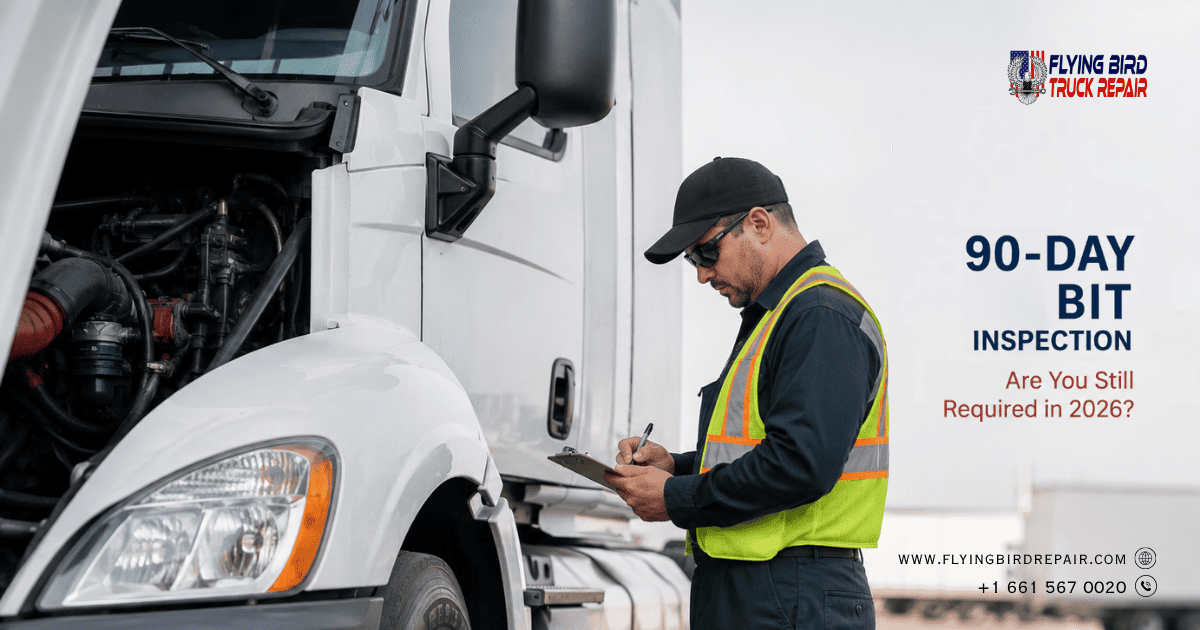
In California, a Basic Inspection of Terminals (BIT) is required every 90 days. This is the best time for a professional technician to catch the small things you might miss, like a frayed air line or a loose slack adjuster.
Why are my brakes “mushy” even though my air pressure is fine?
If the pedal feels soft, you might have what mechanics call “cam-over.” This happens when your shoes are so thin, or your drums are so worn, that the S-cam flips over entirely. When this happens, the brakes will lock up and won’t release, or they won’t apply at all.