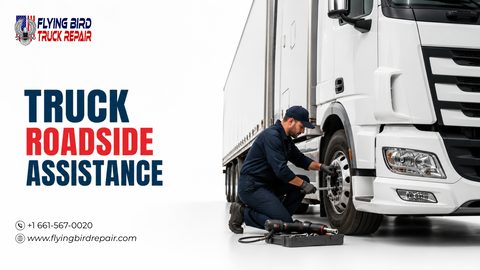
A tire blowout is one of the most high-pressure situations a truck driver can face. One moment you’re cruising down the highway, and the next, you’re fighting to keep your heavy rig in its lane.
While a blowout happens in a split second, the events leading up to it usually take much longer. Understanding why these failures happen and knowing who to call for truck roadside assistance can be the difference between a minor delay and a major catastrophe.
Common Causes of Commercial Tire Blowouts on the Long Haul
Most commercial tire blowouts aren’t accidents; they are the result of physics. On long hauls, several factors work against your rubber:
Under-inflation: This is the leading cause of tire failure. When a tire is low on air, the sidewalls flex more, creating internal heat that eventually causes the casing to snap.
The Bakersfield Heat: Central Valley temperatures are brutal on commercial tires. When the road surface temperature soars, it accelerates the breakdown of already stressed rubber.
Overloading: Excessive weight puts more pressure on the tire than it was designed to withstand, leading to rapid heat buildup.
Road Hazards: Debris on the shoulder or potholes can cause immediate structural damage that might not result in a blowout until miles later.
Preventative Maintenance: Spotting Heavy-Duty Tire Issues Early
Prevention is always cheaper than an emergency call. Incorporate these quick checks into your daily routine:
Use a Gauge, Not a Hammer: For proper commercial tire pressure maintenance, don’t just “thump” your tires. Use a calibrated digital gauge to check the pressure while the tires are cold.
Monitor Your Sensors: If your TPMS (Tire Pressure Monitoring System) alerts you to a slow leak, don’t ignore it. Pull over and inspect the valve stem and tread immediately.
Perform a “Hands-On” Walkaround: Don’t just look; get close. Check for sidewall bubbling, deep cuts, or embedded debris. If you feel a bulge, the tire’s internal structure is compromised and needs to be removed immediately.
Watch for Uneven Wear: If you notice one side of a tire is balding faster than the other, you have a wheel alignment or suspension issue. This accelerates semi-truck tread separation, and that tire will not “make it one more trip.”
Verify Your Load Distribution: Double-check your axle weights. An overloaded axle is a guaranteed way to overheat your tires on a long climb.
Inspect After Rough Patches: If you’ve just come through a construction zone or hit a nasty section of broken pavement, find a safe spot to pull over and verify you haven’t picked up a “nail” or sustained a sidewall cut.
Daily checks are your first line of defense. But they can only catch what the naked eye can see. At Flying Bird Truck Repair, our technicians conduct deep mechanical tire inspections that catch internal sidewall damage, slow bead leaks, suspension misalignment, and early-stage tread separation, the issues that daily walkarounds simply cannot identify. Booking a professional tire inspection every 5,000 miles is one of the smartest investments you can make for your rig and your business.
4 Essential Steps for Safe Highway Blowout Recovery
If the worst happens and a tire blows while you’re at highway speeds, your reaction determines the outcome. Follow these steps:
Step 1: Do NOT Slam the Brakes.
This is the most common instinct, but it’s the most dangerous. Braking hard during a blowout will cause the truck to pull violently to one side, likely leading to a jackknife.
Step 2: Accelerate Slightly.
It sounds completely counterintuitive, but a quick push on the gas uses the heavy drive tires in the back to push the truck forward, overpowering the violent sideways pull of a steer tire failure and giving you back steering control.
Step 3: Coast to the Shoulder.
Once the truck is stable, ease off the accelerator and let the engine slow you down. Use your signals and move as far off the road as possible.
Step 4: Secure the Area.
Put out your reflective triangles or flares immediately. Safety on the shoulder is just as important as safety on the road.
Need Help? Fast 24/7 Truck Roadside Assistance in Bakersfield
When you’re stuck on the side of a busy highway, you don’t just need a mechanic, you need a reliable commercial truck breakdown service and a heavy-duty mobile mechanic who can get to you fast and get the job done right.
At Flying Bird Truck Repair, we specialize in truck roadside assistance tailored for heavy-duty rigs. We understand that every hour your truck sits on the shoulder costs you money. That is why we provide a dedicated 24/7 truck repair and roadside assistance in Bakersfield and the surrounding areas.
Whether it’s a midnight blowout on the Grapevine or a midday failure in the heart of the city, our mobile units are equipped with the heavy-duty jacks, tools, and on-site commercial tire replacement capabilities needed to safely get you back on your route.
Call 661-567-0020 for immediate service needs in Bakersfield.
FAQs
How often should I check my tire pressure?
You should check your tire pressure before every trip and at every major rest stop. Always use a calibrated gauge when the tires are cold for the most accurate reading.
Is a blowout an automatic DOT violation?
A blowout itself isn’t a violation, but driving on a flat or damaged tire is. If a DOT officer catches you moving with a shredded tire, you’re looking at an “out of service” order. It’s always cheaper to call for roadside help than to pay the fines.
I feel a new vibration in the steering wheel; should I be worried?
Always. A new or rhythmic vibration is often the first sign of tread separation, where the rubber is literally peeling away from the steel belts. If you feel a shimmy that wasn’t there 50 miles ago, pull over and check for a distorted tread pattern or a lump in the tire.
Are retreads (recaps) more likely to blow out than new tires?
Not necessarily, if they are maintained. Most road gators (shredded tire pieces) you see on the highway are caused by under-inflation, not the recap itself. However, recaps are more heat-sensitive. If you’re running recaps on a long haul through the Central Valley, checking your PSI is even more critical.
What is the most dangerous type of blowout for a truck?
A steer tire blowout is the most critical because it directly impacts your ability to guide the rig. If a steer tire goes, maintaining your grip on the steering wheel and avoiding the brakes is the only way to prevent the truck from pulling into a ditch or oncoming traffic.