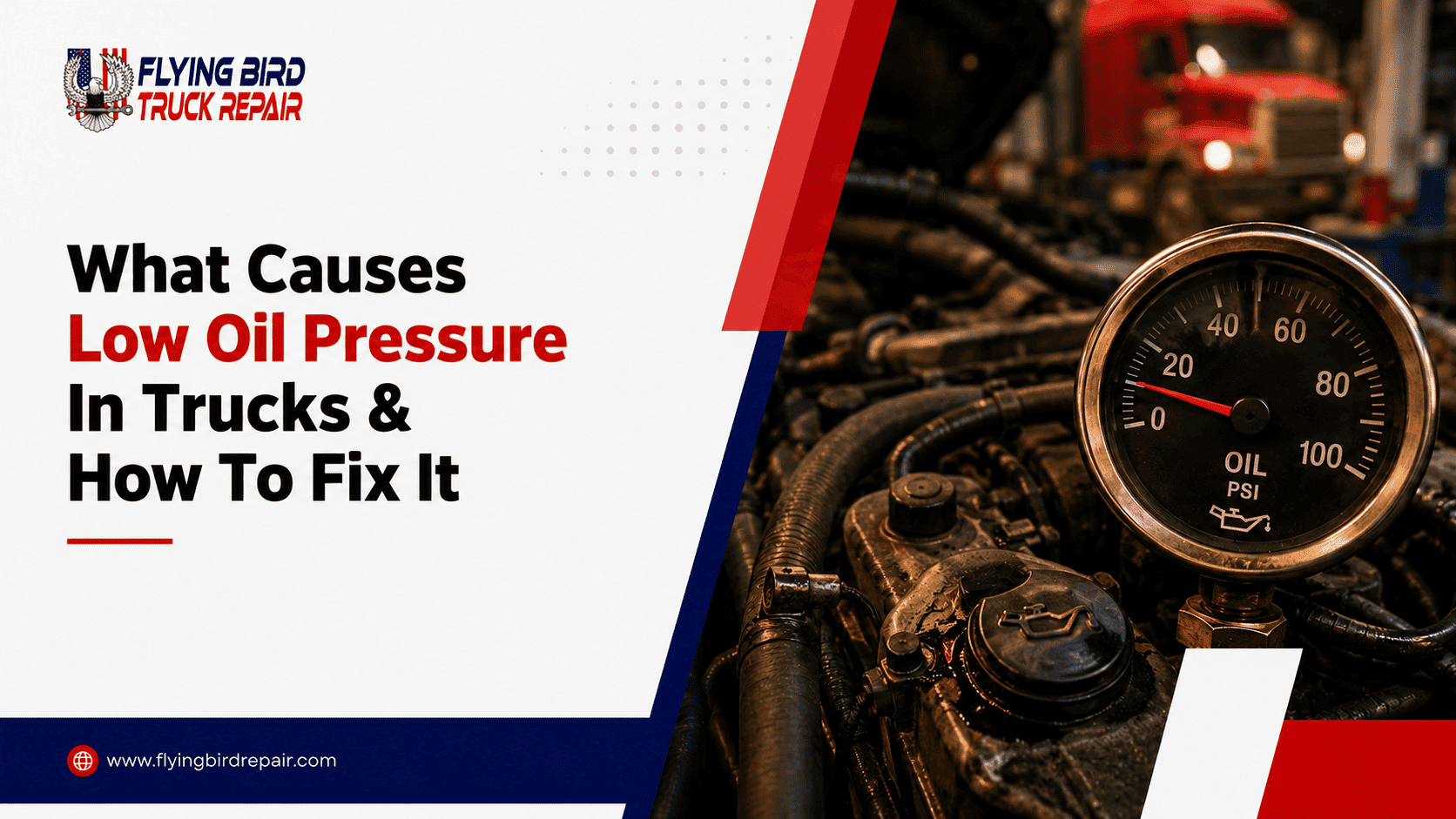
That oil-pressure gauge on your truck’s instrument cluster isn’t lying. When it falls, there’s trouble, and you need to know “what it is” before a warning light turns into a five-figure engine rebuild. Low oil pressure is one of the most severe distress signals your truck can send out. Ignore it, and you’re risking not only spun bearings but a completely seized motor.
Don’t panic, but don’t guess, either. In this article, we will cover the causes of low oil pressure in trucks, how to tell the difference between a major engine repair and a routine truck oil change, and what to do next.
Stop the Truck First
Don’t try to make the next exit. Don’t limp to the truck stop. A diesel engine running without proper oil pressure can destroy itself in minutes. Metal-on-metal with no lubrication is a death sentence for your motor. Get off the road safely, shut off the engine, and then start diagnosing.
What are the Common Reasons for Low Oil Pressure in Trucks?
1. Low Oil Level
Most of the time, this is the problem. If your oil level is low, the pump starts sucking air instead of oil, and the pressure tanks fast.
Oil disappears in two ways: it leaks out (bad gaskets, worn seals, cracked pan) or it burns off past the rings. Either way, you’re losing it somewhere.
Pull the dipstick. If it’s low, top it off with the right-weight oil for your engine. Start it back up and watch the gauge. If pressure comes back, great, but now you need to hunt down that leak before you’re in this spot again.
2. Fuel Diluting Your Oil
This one sneaks up on you, especially on high-mileage rigs. A leaky injector or a faulty DPF regeneration cycle can push raw diesel fuel past the rings and into your oil pan. Diesel is thin. Once it mixes with your engine oil, that oil can’t hold pressure anymore; it just flows right through.
Pull the dipstick and smell it. Diesel smell? Your oil level might even read higher than normal because of the extra fluid in the pan.
Don’t drive it. Drain the contaminated oil, replace the bad injectors or injector O-rings, and start fresh with clean oil and a new filter.
3. Clogged Filter or Blocked Pickup Tube
Skip too many oil changes and sludge builds up. A clogged filter chokes the flow. Worse, if debris or thick sludge blocks the mesh screen on your pickup tube (the straw the pump uses to pull oil from the pan), the pump is completely starved.
No flow = no pressure. Simple as that.
Start with a fresh oil and filter change. If you still find low oil pressure, a mechanic needs to drop the pan and clean out the pickup tube screen. This is a maintenance problem; stay on your service schedule, and you’ll never deal with it.
4. Worn Engine Bearings
High-mileage engines wear down over time. The gaps between your rod and main bearings widen, and oil slips right through instead of building pressure. Think of it like a leaking garden hose; you can’t build pressure if the fluid is escaping faster than the pump can push it.
This usually shows up gradually. Pressure starts dropping at idle first, then creeps lower overall.
There’s no roadside fix here. A diesel tech needs to pull the pan, inspect the bearing clearances, and either roll in new bearings or call for a full engine overhaul. The longer you wait, the worse it gets.
5. Oil Pump or Relief Valve Failure
The oil pump can also wear out over time, particularly in engines with very high mileage. In addition, all pumps are equipped with a pressure relief valve that vents any excess pressure if the pressure goes too high. And if that valve is stuck open, generally by a teeny tiny piece of debris, every bit of your oil gets dumped back into the pan, and your pressure just dies.
That means dropping the oil pan and physically replacing the faulty oil pump or a stuck relief valve. This is a heavy-duty job that a professional diesel repair technician can handle.
6. Bad Oil Pressure Sensor
Sometimes the engine is fine, and the sensor is lying to you. A failed pressure sensor, a corroded connector, or a chafed wire can trigger a false alarm on the gauge or warning light.
A mechanic pulls the electronic sensor and threads in a mechanical gauge directly into the block. If the mechanical gauge reads normal, your engine is good; you just need a new sensor. It’s a cheap part and a quick fix.
What’s Normal Oil Pressure for a Heavy-Duty Diesel?
Every engine is a little different, but here’s a solid approximation:
At idle: 15–20 PSI
Cruising/under load: 35–50+ PSI
If you’re sitting at idle and seeing less than 10 PSI, or running down the highway below 30 PSI, shut it down and call a shop. Don’t push it.
Don’t Ignore Low Oil Pressure Warnings
You can’t drive with low oil pressure and just hope for the best. It’s your engine telling you it has a problem. Whether it’s a leaky gasket, fuel-soaked oil, or a failing pump, find the cause before you turn a fixable problem into a full engine replacement.
Whether you need a routine truck oil change service or advanced diagnostics to find a failing sensor, the certified mechanics at Flying Bird Truck Repair can help identify the root cause of your low oil pressure. We provide 24/7 mobile roadside service and full-shop repairs in Bakersfield, CA.
Contact us today to get your rig diagnosed and safely back on the road.
FAQs
Can I drive my truck with low oil pressure?
No. Stop the engine immediately. Even light driving with low oil pressure can cause havoc with your engine bearings and eventually seize the engine, turning a simple oil pressure problem into a full engine rebuild.
What is the first thing to check when oil pressure drops?
Start with the dipstick. Check your physical oil level first; it’s the most common cause and the easiest fix. If the level is fine, move on to checking for leaks or a faulty sensor.
Can a bad oil pressure sensor cause a false alarm?
Yes, indeed. A sensor malfunction or wiring corrosion can falsely indicate low pressure when the engine is just fine. Using a mechanical gauge, a mechanic can quickly confirm this.
How do I know if fuel is mixing with my engine oil?
Pull the dipstick and sniff it. If it smells like diesel or if your oil level is higher than usual, then fuel is contaminating your oil. Stop driving it and get it checked out now.
What is normal oil pressure for a semi-truck?
Generally, 15–20 PSI at idle and 35–50+ PSI at highway speeds is normal for most heavy-duty diesels. A reading below 10 PSI at idle is a warning sign.
How often should I check my oil to prevent low-pressure issues?
Check oil level every time you do a pre-trip inspection, ideally daily. Catching a slow leak or low level early costs you nothing. Ignoring it can cost you an entire engine.